
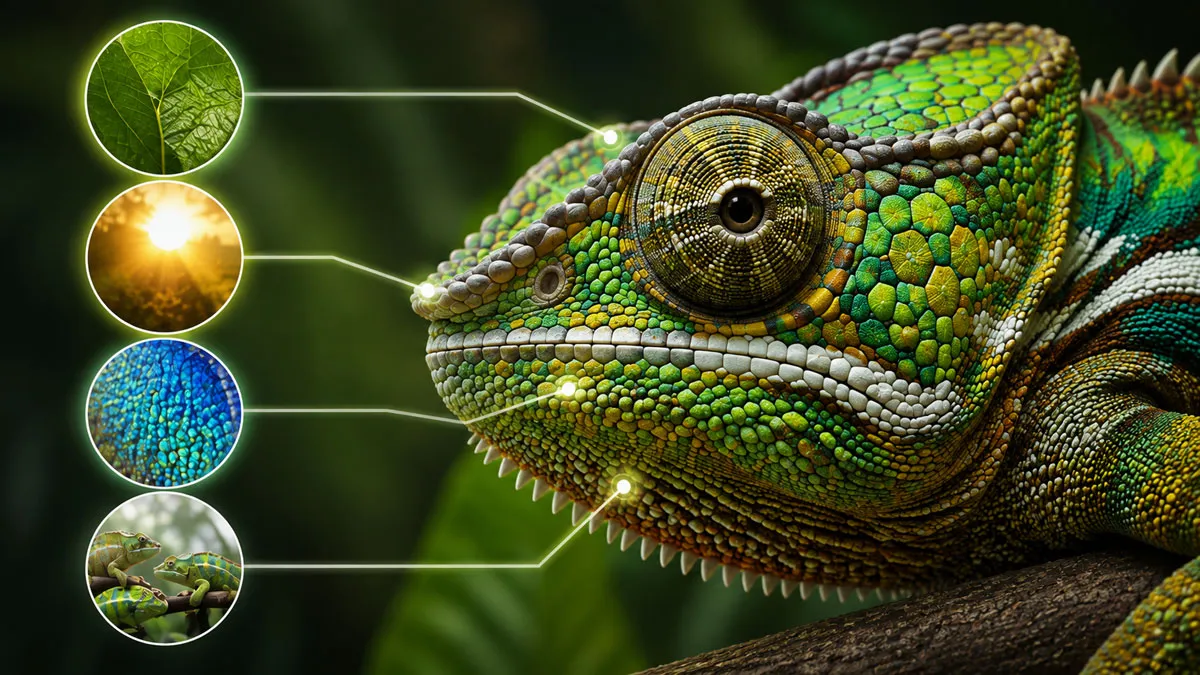
Chameleons change color primarily to communicate, respond to their surroundings, regulate aspects of their body temperature, and signal changes in their physical or emotional state. The familiar idea that a chameleon changes color simply to match whatever it is sitting on is misleading. A chameleon’s normal skin pattern already provides much of its camouflage, while rapid color changes often become especially noticeable during social interactions, courtship, competition, stress, or changes in environmental conditions.
The remarkable part is how the color change happens. Specialized skin cells called chromatophores contain or control pigments, while another type of cell called an iridophore reflects light using microscopic structures. In some chameleons, including the panther chameleon, changes in the spacing of guanine nanocrystals inside iridophores alter which wavelengths of light are reflected. This allows the animal to produce striking shifts in visible color without simply adding or removing pigment.
What Causes A Chameleon’s Color To Change?
Color change is controlled by the chameleon’s nervous and hormonal systems, which influence specialized cells in the skin. The exact mechanism varies among species, so there is no single color-changing process shared in precisely the same form by every chameleon.
In panther chameleons, researchers have found that a superficial layer of iridophores contains an organized lattice of guanine nanocrystals. When the animal changes state, the spacing between these crystals changes. Because the crystals interact with light in a precise physical way, altering their spacing changes the wavelengths that are reflected and therefore the color that an observer sees.
Other skin structures also contribute to the final appearance. Pigment-containing cells can alter the brightness and intensity of the skin, while deeper iridophores can reflect substantial amounts of near-infrared radiation. The visible color seen by an observer is therefore produced by several layers and types of skin cells working together.
Why Do Chameleons Change Color?
Communication With Other Chameleons
Color is an important visual signal during social interactions. A male may become more vividly colored when encountering another male or when courting a female. These changes can make the animal’s body patterns more conspicuous and communicate information about its current state.
Color signals can also appear during aggressive encounters. A chameleon may change its appearance when confronting a rival, helping communicate that the interaction is serious without relying entirely on physical combat.
- Courtship: Brighter or more contrasting colors can accompany reproductive displays.
- Competition: Color changes can occur when males encounter potential rivals.
- Stress: Distress or agitation can produce darker or otherwise altered coloration in some species.
- Social signaling: Changes in appearance can communicate a chameleon’s current behavioral state.
- Environmental response: Some color changes are associated with conditions such as temperature and light.
Regulating Body Temperature
Color can also influence how much solar radiation a chameleon absorbs. Darker skin generally absorbs more visible radiation than lighter skin, although the relationship between color and temperature is more complicated than simply “dark means warmer.”
Chameleon skin contains deeper iridophore layers that can reflect near-infrared radiation. In panther chameleons, this layer has been shown to reflect a substantial portion of near-infrared light, potentially reducing the amount of solar energy absorbed by deeper tissues. This means that some of the skin’s optical structures have a role beyond producing visible colors.
Camouflage Is Only Part Of The Story
Camouflage does matter for chameleons, but it is often overstated. Their natural patterns and coloration can help them blend into vegetation and their usual habitat. However, a chameleon does not normally scan its surroundings and instantly reproduce the exact color of a branch, leaf, or background.
Rapid, dramatic color changes are particularly important for communication. For example, an excited panther chameleon can shift from relatively subdued green and blue tones toward yellow, orange, or brighter colors during social interactions. That kind of transformation is better understood as a signal than as an attempt to become invisible.
How Chameleon Color Change Differs From Simple Pigment Change
It is tempting to imagine that changing color simply means moving colored pigment around under the skin. Pigment movement is involved in reptile coloration, but it does not fully explain the striking color shifts observed in some chameleons.
In panther chameleons, structural color plays a particularly important role. Their iridophores contain tiny guanine crystals arranged in a structure that interacts with light. When the spacing between these crystals changes, the reflected color changes as well.
| Skin Structure | Primary Role | Contribution To Color |
|---|---|---|
| Chromatophores | Control pigment-based coloration and brightness | Can influence darker, lighter, and pigment-rich tones |
| Superficial iridophores | Produce structural color in species such as the panther chameleon | Reflect different wavelengths as nanocrystal spacing changes |
| Deeper iridophores | Reflect incoming radiation | Strongly reflect near-infrared wavelengths and may reduce solar heat absorption |
Do All Chameleons Change Color In The Same Way?
No. Chameleon species differ considerably in their natural coloration, patterns, and ability to produce rapid color changes. The detailed cellular mechanisms have been studied especially closely in species such as the panther chameleon, but those findings should not automatically be applied to every chameleon species in exactly the same way.
The purpose of a particular color change can also depend on the situation. A change associated with courtship is not necessarily produced for the same reason as a change associated with stress or environmental conditions. This is why interpreting a chameleon’s color requires considering its species, behavior, surroundings, and the circumstances in which the change occurs.
How Fast Can A Chameleon Change Color?
Some chameleons can produce noticeable changes within minutes. Research on adult male panther chameleons has documented reversible shifts in skin color during excitation and social interactions. The speed and intensity of the response depend on the species and the type of color change involved.
This rapid response is possible because the animal does not need to grow new pigment or replace its skin. Instead, existing cellular structures can alter how light is absorbed or reflected. In panther chameleons, changing the organization of the nanocrystal lattice in the superficial iridophores can produce a reversible shift in reflected wavelengths.
What A Chameleon’s Color Can Tell You
A color change should not be interpreted as a universal mood chart. The same general color category can have different meanings depending on the species and circumstances. Bright coloration may be associated with courtship or competition, while darker coloration can accompany stress in some species.
For that reason, behavior provides important context. Body posture, interaction with another chameleon, movement, environmental temperature, and the animal’s normal coloration can all help explain why its appearance has changed.
The Main Reason Chameleons Change Color
Chameleons change color because their skin is a sophisticated optical and signaling system, not simply a camouflage surface. Color can help communicate during courtship and competition, accompany stress responses, and influence how the animal interacts with solar radiation. Camouflage is part of the picture, but it does not explain the full range of rapid color changes seen in these reptiles.
The most remarkable aspect is the physical mechanism behind the display. In some chameleons, microscopic guanine nanocrystals inside specialized skin cells act like a tunable optical structure. By changing their spacing, the animal can alter which wavelengths of light are reflected. What looks like a simple change from green to yellow or orange is therefore the visible result of complex biological control occurring at the microscopic level. …