
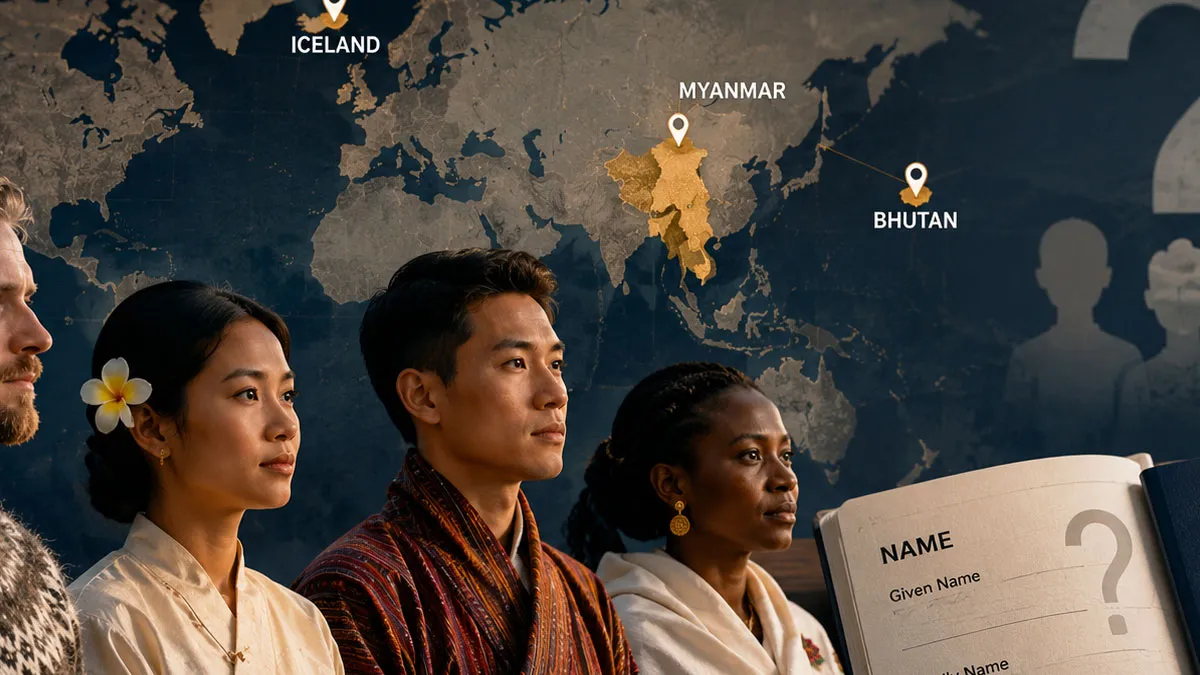
Not every country follows the Western convention of giving people a first name followed by an inherited family surname. In several countries, names are instead based on personal names, a parent’s name, clan affiliation, or another local naming tradition. As a result, a person may have a perfectly complete legal name without having a hereditary surname.
The distinction matters when filling out passports, airline forms, databases, school records, or other systems designed around “first name” and “last name” fields. Countries such as Iceland, Myanmar, Indonesia, Ethiopia, and Somalia have important naming traditions in which an inherited family surname is not the standard for at least a substantial part of the population. These systems are not identical, however, so saying that an entire country simply “has no surnames” can be misleading.
Countries Where Inherited Surnames Are Not The Standard
| Country | Common Naming Pattern | How Family Names Differ |
|---|---|---|
| Iceland | Given name plus patronymic or matronymic | Hereditary family surnames are uncommon |
| Myanmar | Personal name made from several name elements | Most people do not traditionally inherit a family surname |
| Indonesia | Single or multiple personal names | Most Indonesians do not have a nationally inherited surname tradition |
| Ethiopia | Personal name plus father’s name | The father’s name generally does not become a permanent family surname |
| Somalia | Personal name plus father’s name plus grandfather’s name | The naming sequence is traditionally genealogical rather than a hereditary surname |
Iceland Uses Patronymics And Matronymics
Iceland is one of the clearest examples of a country where the conventional inherited surname is not the normal naming system. A child’s name commonly incorporates the first name of the father or mother rather than a family surname passed unchanged from one generation to the next.
For example, a boy whose father is named Jón may receive a name ending in -son, while a girl may receive a name ending in -dóttir. The resulting names identify the person’s relationship to a parent rather than membership in a permanent surname-bearing family.
This means that members of the same household can have different surnames. Iceland’s official information service states that family names passed down through generations are uncommon and are permitted only under certain exceptions.
Myanmar Traditionally Has No Hereditary Family Surname
Traditional Burmese naming is also very different from the Western first-name-and-surname model. Among major ethnic groups that follow Burmese naming conventions, the components of a person’s name are generally treated as one personal name rather than as a given name followed by an inherited family name.
A person’s name therefore does not normally identify a hereditary surname shared by parents and children. Myanmar is ethnically diverse, however, and some communities use inherited family names. The safest description is therefore that most people following traditional Burmese naming conventions do not use surnames in the Western sense, rather than claiming that nobody in Myanmar has one.
- A Burmese name may contain several components without a separate surname.
- Names are not normally passed unchanged from parent to child as a family surname.
- Some ethnic communities have different naming traditions.
- Honorifics and other name elements should not automatically be interpreted as surnames.
Indonesia Has Many People Without Family Surnames
Indonesia has no single naming system shared by all ethnic groups. Many Indonesians have no inherited family surname, and some have a single personal name. Others have several name elements that are all part of the person’s full name rather than a first name, middle name, and surname.
This is particularly important because Indonesia’s naming traditions vary considerably between communities. Some groups, including Batak communities, use inherited clan names, while other Indonesians do not. Consequently, the presence of a final element in an Indonesian name does not automatically mean that it is a surname.
The absence of a surname does not mean that the person’s official name is incomplete. Problems can arise when international forms require a mandatory surname field even though the person’s own naming tradition does not divide the name in that way.
Ethiopia Uses A Generational Naming System
Ethiopian naming conventions commonly use a person’s own name followed by the father’s personal name. A third name may represent the grandfather’s personal name. Unlike a hereditary surname, these names change from one generation to the next.
For example, if a father is named Bekele and his child is named Daniel, the child may be known as Daniel Bekele. If Daniel later has a child named Hana, Hana’s second name would normally be Daniel rather than Bekele. The name therefore communicates lineage without functioning as a permanent family surname.
This distinction is particularly important in official records and academic citations. Treating the final element of an Ethiopian name as a Western-style surname can incorrectly separate a person’s name from its actual naming structure.
Somali Names Identify Family Lineage Without A Family Surname
Traditional Somali naming commonly consists of three personal names: the individual’s own name, the father’s name, and the paternal grandfather’s name. The sequence provides information about ancestry, but it is not equivalent to an inherited surname shared unchanged by an entire family.
For instance, a father, his son, and his grandson can have different three-part names because each generation’s sequence moves forward through the paternal line. Women traditionally retain their own names rather than automatically adopting their husband’s name after marriage.
Why “No Surname” Does Not Mean “No Family Identification”
A surname is only one way of connecting people to families. Naming systems without inherited surnames can communicate family relationships through patronymics, matronymics, clan names, or successive generations of personal names.
The major difference is whether the identifying element is inherited unchanged as a family name. In a conventional surname system, several generations can share the same family name. In a patronymic system, the identifying element may change with every generation.
| Naming System | What The Name Usually Identifies | Does It Stay The Same Across Generations? |
|---|---|---|
| Hereditary surname | Family or lineage | Usually yes |
| Patronymic | Father or paternal relationship | Usually no |
| Matronymic | Mother or maternal relationship | Usually no |
| Clan name | Clan or broader lineage | Often yes |
| Mononym | Individual person | Not applicable |
What Happens When A Form Requires A Surname?
People without surnames can encounter difficulties when dealing with systems built around Western naming conventions. An online form may require both a given name and a family name even when a person’s official identity document contains only one name or uses a different naming structure.
The correct way to handle this depends on the specific country, document, institution, and form. Do not invent a family surname simply because a website requires one. Passport authorities, airlines, universities, immigration offices, and government agencies may have their own procedures for entering mononyms or non-Western names.
The same principle applies when reading names from countries without conventional surnames. The final word in a name is not necessarily the surname, and two people with different final names may still belong to the same family.
Are There Other Countries Without Surnames?
Yes, but the answer becomes more complicated when countries with multiple ethnic and linguistic communities are considered. Some societies have several naming traditions operating at the same time, while others have experienced changes caused by migration, colonial administration, religious practices, or modern legal registration systems.
It is therefore more accurate to describe specific naming traditions than to produce a rigid list of countries where nobody has a surname. Iceland is unusual because its national naming convention is formally structured around patronymic and matronymic names, while Indonesia and Myanmar illustrate countries where different communities can follow substantially different naming practices.
The key point is that a surname is not a universal requirement for a complete personal identity. In many cultures, a person’s name can encode individual identity and family relationships without using a hereditary last name. …