
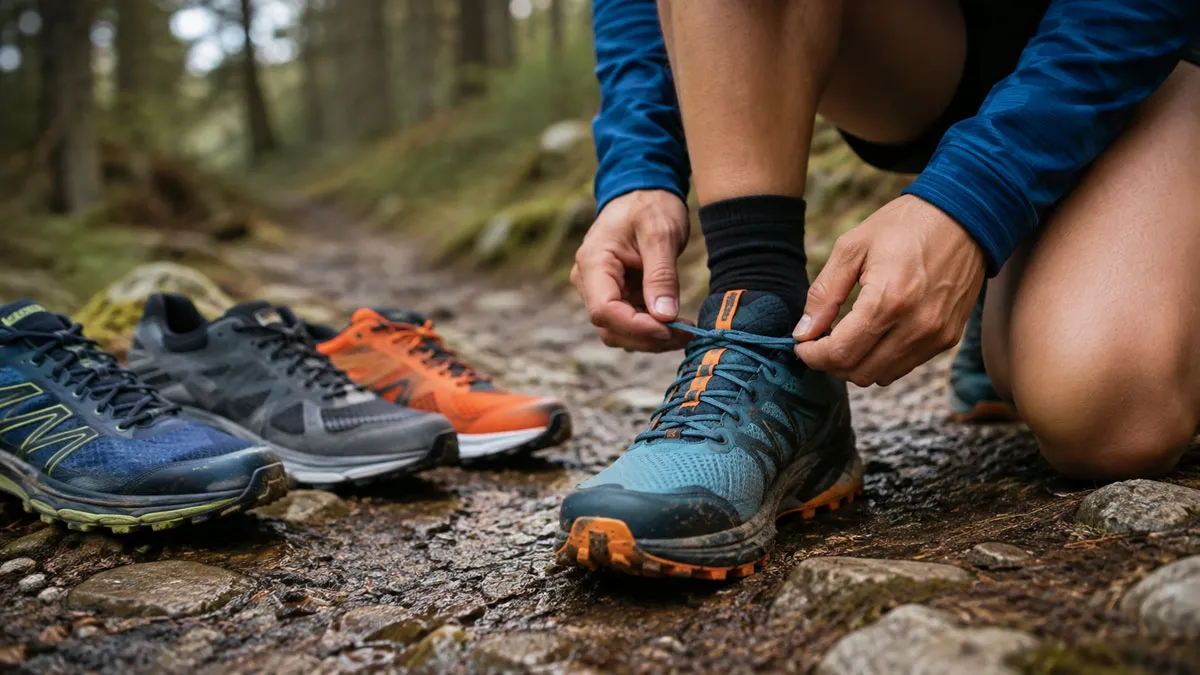
Choosing running shoes starts with how and where you run, not with a particular brand, color, or appearance. A suitable pair should fit securely, leave enough room for your toes, and feel comfortable throughout your normal running motion. Your usual distance, running surface, pace, foot shape, and preferred level of cushioning all help narrow the choices.
There is no single running shoe that works equally well for everyone. A shoe that feels excellent to one runner may feel too narrow, too soft, too firm, or insufficiently stable to another. The most useful approach is to treat fit and comfort as the foundation, then consider shoe type, terrain, cushioning, stability, and heel-to-toe drop.
Start With Where And How You Run
The best shoe category depends heavily on your typical running environment. Road shoes are designed for paved surfaces and generally emphasize cushioning, smooth transitions, and relatively low weight. Trail shoes use outsoles with more traction and often provide additional protection against rocks, roots, and uneven ground. Racing shoes are designed around speed and responsiveness, while everyday trainers usually place greater emphasis on comfort and durability.
| Running Situation | What To Prioritize | Typical Shoe Characteristics |
|---|---|---|
| Road running | Comfort and smooth movement | Cushioned, flexible, road-oriented outsole |
| Trail running | Grip and protection | Aggressive traction and more protective construction |
| Long-distance training | Comfort over extended runs | Cushioning and a secure, comfortable fit |
| Speed sessions or racing | Responsiveness and weight | Lighter construction and a more performance-focused ride |
| Mixed everyday training | Versatility | Balanced cushioning, stability, and durability |
Think about your actual training rather than an idealized version of it. If most of your runs are on roads, a trail shoe may add unnecessary weight and aggressive tread. Conversely, a conventional road shoe may not provide the traction or protection needed for technical trails.
Get The Fit Right Before Comparing Features
Fit is one of the most important parts of choosing a running shoe. The heel and midfoot should feel secure without excessive pressure, while the front of the shoe should give your toes enough room to move. A commonly recommended starting point is roughly a thumb’s width of space between your longest toe and the end of the shoe.
- Try on both shoes, because your feet may differ slightly in size or shape.
- Wear the socks you normally use for running.
- Check that your heel stays secure without painful pressure.
- Make sure your toes can move rather than being squeezed together.
- Test the shoe by walking or jogging rather than judging it while standing still.
- Consider your foot width as well as length; a longer shoe is not always the solution to a shoe that is too narrow.
Trying shoes later in the day can also be useful because feet can become larger during the day and during prolonged activity. The exact size you need should be based on the fit of the shoe rather than a fixed assumption that running shoes must always be a particular size larger than everyday footwear.
Consider Foot Shape And Pronation
Pronation describes how the foot rolls inward as it accepts weight during a stride. Runners may have a relatively neutral motion, greater inward rolling often described as overpronation, or greater outward rolling known as underpronation or supination. Shoe categories are sometimes designed with different approaches to stability and cushioning to accommodate these movement patterns.
That does not mean you should automatically buy a stability shoe simply because you have been told that you overpronate. Running mechanics are more complicated than one measurement, and comfort remains an important part of shoe selection. If you have persistent discomfort or a history of running-related problems, a qualified healthcare professional can provide more appropriate individual assessment.
A specialist running store can also assess your movement and let you compare several shoes. This can be particularly helpful if you are unsure whether a neutral or stability-oriented design feels more natural.
Choose Cushioning Based On Comfort And Use
Cushioning describes the amount and characteristics of foam or other material between your foot and the ground. More cushioning can provide a softer, more protected sensation, which some runners prefer for longer runs. Less cushioning can provide a more direct connection with the ground. Neither approach is automatically better for every runner.
It is also useful to separate cushioning from softness. A shoe can contain a substantial amount of foam without feeling extremely soft, while a shoe with less material can still have a noticeably soft ride. Stability can likewise come from factors such as a wider platform, the geometry of the midsole, or other structural features rather than simply from making the shoe firmer.
Understand Heel-To-Toe Drop
Heel-to-toe drop, also called offset, is the difference in height between the heel and forefoot of a shoe. It is measured in millimeters. As a general classification, a drop above 8 mm is considered high, 5–8 mm moderate, and 4 mm or less low; zero-drop shoes have the same nominal height at the heel and toe.
Drop can influence how a shoe feels during your stride, but it should not be treated as a measure of shoe quality. If you are comfortable in your current shoes, there is usually little reason to change drop simply because another number is marketed as superior. A substantial change, particularly toward a much lower or zero-drop shoe, is better approached gradually because it can alter the demands placed on the lower leg and Achilles tendon.
Use A Simple Shortlist
Once you know your running surface, preferred fit, and general shoe characteristics, avoid comparing dozens of models on every specification. Narrow your options to a few shoes that meet your basic requirements and then compare how they actually feel on your feet.
For most runners, a practical selection process looks like this:
- Identify whether you mainly run on roads, trails, tracks, or a mixture of surfaces.
- Choose a suitable shoe category for that environment.
- Check length, width, heel security, and toe-box space.
- Consider whether neutral or stability-oriented construction feels appropriate.
- Choose cushioning and drop based on your current running habits and comfort.
- Try several suitable models and select the one that feels secure and comfortable while moving.
Do not assume that the most expensive shoe, the softest shoe, or the shoe with the most technical features will be the right choice. A well-fitting everyday trainer that suits your running surface and feels natural can be a more appropriate option than a highly specialized model that does not match your needs.
When Should You Replace Running Shoes?
Shoe replacement should not be based solely on an arbitrary mileage number. How quickly a shoe changes depends on the model, runner, body weight, running surface, training volume, and construction. Pay attention to changes in cushioning, stability, fit, visible wear, or the way the shoe feels during runs.
If a previously comfortable pair begins causing unusual rubbing, feels substantially less supportive, or has developed obvious structural wear, those are practical reasons to reassess it. Keeping a simple record of when you started using a pair can help you notice how long it remains comfortable, but your experience with the shoe is more useful than treating a mileage figure as an exact expiration date.
What To Look For When Buying Running Shoes Online
Online shopping removes the advantage of trying a shoe on before purchase, so use measurements and return policies carefully. Check the manufacturer’s sizing information, available widths, heel-to-toe drop, intended terrain, and cushioning category. Reviews can help identify recurring fit characteristics, but individual foot shape means that another runner’s experience is not a guarantee of how the same shoe will fit you.
If possible, choose a retailer with a clear return or exchange policy and inspect the shoes indoors before committing to them. Pay particular attention to toe pressure, heel movement, width, and overall comfort. The goal is not simply to find a shoe with impressive specifications; it is to find a shoe that fits your feet and supports the way you actually run.
…