
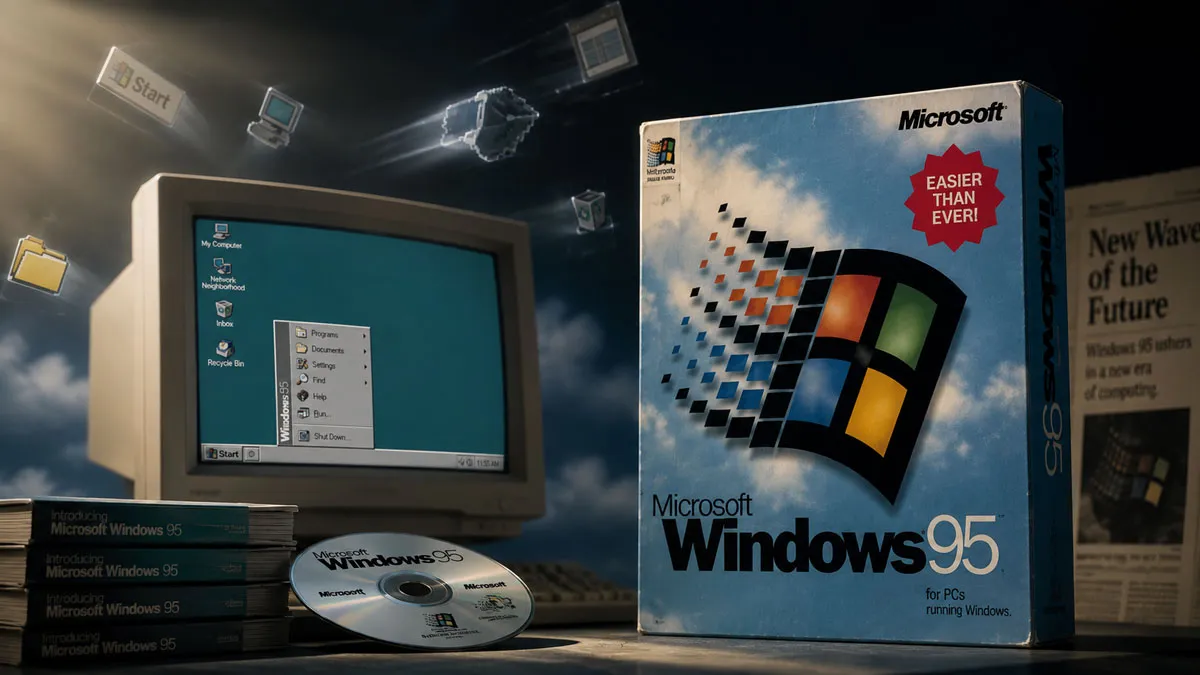
Few software releases have had the cultural impact of Windows 95. When Microsoft launched it on August 24, 1995, personal computers were becoming more common in homes and offices, while the internet was beginning to move from a specialist interest toward mainstream use. Windows 95 arrived at exactly that moment and made everyday PC use feel considerably more approachable, with the Start menu, taskbar, desktop shortcuts, Recycle Bin, and simpler hardware installation becoming part of the experience.
Its importance was not based on a single feature. Windows 95 combined a more accessible interface with 32-bit computing, multitasking, networking, Plug and Play hardware support, and easier access to emerging online services. The launch itself also became a major cultural event, with midnight store openings and long customer lines. Microsoft reported that Windows 95 sold seven million copies in its first five weeks and more than 40 million units within its first year.
It Changed How People Used A PC
Before Windows 95, Windows 3.x users commonly worked through Program Manager and File Manager. Windows 95 introduced a desktop layout that became familiar to generations of computer users: a Start button, a taskbar for switching between open programs, desktop shortcuts, and a Recycle Bin for deleted files.
The significance of these elements is easy to underestimate because they became so familiar. The Start menu gave users a central place to find programs and system functions. The taskbar made multiple open applications easier to manage, while minimize, maximize, and close buttons provided a consistent way to control windows. Microsoft later described these interface changes as an important part of Windows’ evolution toward making PCs easier for a broad audience to use.
- Start menu: Provided a central way to access programs and system functions.
- Taskbar: Made switching between open applications much more straightforward.
- Desktop shortcuts: Put frequently used files, folders, and programs within easy reach.
- Recycle Bin: Offered a familiar place for deleted files before permanent removal.
- Plug and Play: Simplified the process of adding compatible hardware.
Windows 95 Arrived At The Right Moment
Timing was one of its defining advantages. In the mid-1990s, PCs were moving beyond specialist and business environments and becoming increasingly important in homes. At the same time, email, online services, and the World Wide Web were gaining attention.
Windows 95 was designed for this transition. It provided built-in networking capabilities and a TCP/IP stack, making internet connectivity more accessible than it had been on earlier mainstream Windows versions. Internet Explorer also became part of Microsoft’s Windows strategy around this period, although the original Windows 95 release and later browser additions should not be treated as exactly the same product configuration.
| Area | What Windows 95 Changed | Why It Mattered |
|---|---|---|
| User interface | Start menu, taskbar, desktop shortcuts, and familiar window controls | Made everyday navigation easier to understand |
| Hardware | Plug and Play support | Simplified installation of compatible devices |
| Software | Stronger support for 32-bit applications | Provided a foundation for newer Windows software |
| Networking | Integrated networking and TCP/IP support | Helped PCs participate in the rapidly expanding online world |
It Made The PC Feel More Like A Consumer Product
Windows 95 was also notable for how Microsoft marketed it. The release was treated less like an ordinary software update and more like a major consumer technology event. Stores held midnight launches, customers lined up to buy copies, and Microsoft promoted the operating system extensively around the world.
The launch helped turn an operating system into something the general public could recognize as a major product. That mattered because software had traditionally been far less visible to consumers than the computers running it. Windows 95 gave Microsoft a product identity that extended beyond technical specifications and into popular culture.
Its Technical Changes Mattered Too
The familiar interface was only one part of the story. Windows 95 represented an important transition from the predominantly 16-bit Windows environment associated with Windows 3.x toward a system capable of supporting 32-bit applications and modern hardware more effectively.
It also improved multitasking and networking and introduced support for longer file names compared with the restrictive naming conventions associated with older DOS-based computing. These changes were not equally visible to every user, but together they created a more capable foundation for software developers and PC manufacturers.
Why Windows 95 Still Feels Legendary
Its legacy comes from the combination of technology, timing, design, and cultural visibility. Many features introduced or popularized by Windows 95 became so deeply embedded in desktop computing that later generations stopped thinking of them as innovations.
The sales figures show how quickly the operating system reached users. Microsoft reported more than 40 million Windows 95 units shipped worldwide by its first anniversary. That scale gave the interface an enormous installed audience, which in turn encouraged software developers and hardware manufacturers to support the platform.
Windows 95 therefore became more than a successful version of Windows. It helped establish a common visual and functional language for personal computers at the moment when PCs were becoming increasingly connected, affordable, and mainstream. Even though modern operating systems are vastly more sophisticated, the basic relationship between the user, the desktop, the taskbar, the Start menu, and open applications remains recognizable.
That is the central reason Windows 95 remains legendary: it did not simply improve the PC; it helped define what using a PC was supposed to feel like for an entire generation. …