
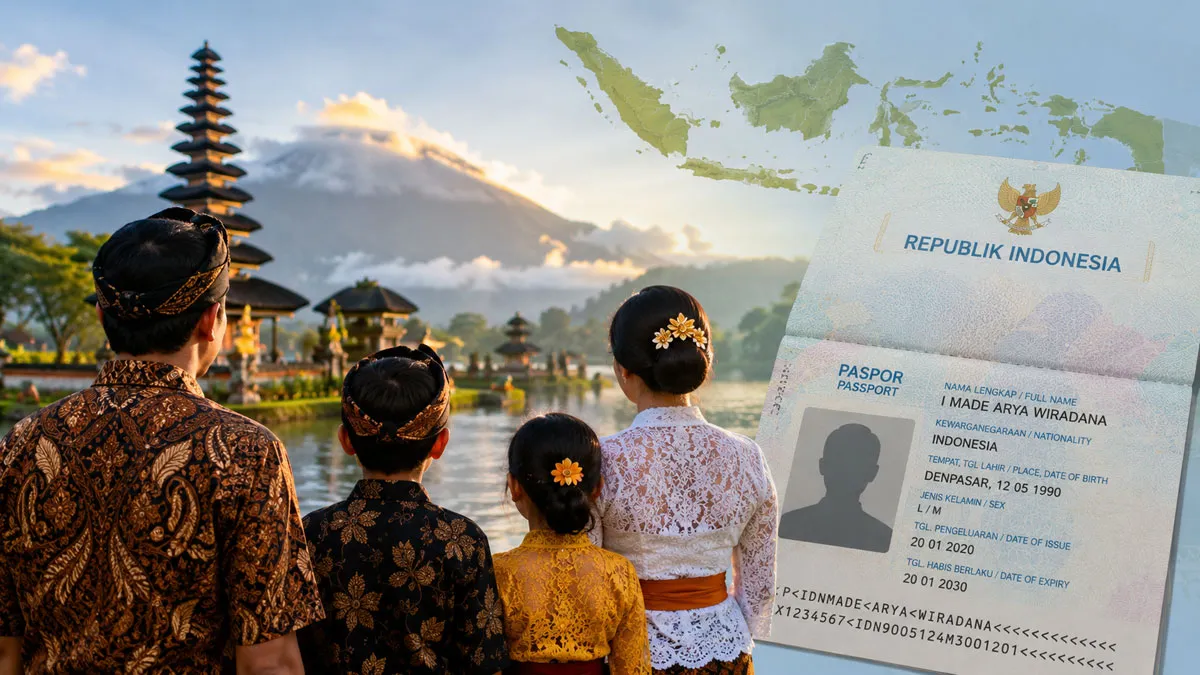
Many Indonesians do not have a surname in the Western sense, but saying that Indonesians have “no surnames” is too broad. Indonesia has hundreds of ethnic groups, and naming traditions differ considerably between communities. For many Javanese and other Indonesians, a person may have a single given name or several personal names without inheriting a family name from either parent.
Other Indonesian communities do use hereditary family or clan names. Batak communities, for example, have well-established marga or clan names, while some Minahasan, Balinese, and other communities have their own distinctive naming systems. Indonesian law also explicitly allows a marga, family name, or equivalent name to be included in civil documents.
Why Many Indonesians Do Not Use Surnames
The main reason is that the Western pattern of a given name followed by an inherited family surname has never been a universal Indonesian naming convention. In many communities, names traditionally identify an individual rather than placing that person into a single hereditary surname shared by the whole nuclear family.
This is particularly familiar among Javanese people, who form Indonesia’s largest ethnic group. A Javanese person’s name can consist of one word or several words, and those words do not necessarily function as a first name, middle name, and surname. Naming practices have also changed over time as Indonesian communities adopted names influenced by Javanese, Arabic, Sanskrit, Dutch, and other linguistic and cultural traditions.
As a result, two siblings can have completely different names without sharing a final family name. Likewise, a child’s name does not necessarily reveal the name of either parent.
Not Every Indonesian Naming System Works The Same Way
Indonesia is culturally diverse, so the absence of a surname in one community should not be treated as a national rule. Different ethnic groups have developed different ways of expressing family relationships, ancestry, social identity, and place of origin through names.
- Javanese: hereditary surnames are not generally required, and many people have personal names without a family surname.
- Batak: many people use a marga, or clan name, as an important marker of kinship and identity.
- Other ethnic communities: naming traditions can include hereditary family names, clan names, lineage markers, or other culturally specific elements.
- Modern Indonesian families: some parents choose to give their children a shared family name even when it was not part of their own traditional naming system.
Batak Toba naming provides a particularly clear contrast. Research on the community describes marga as a family or relative name and identifies it as one element of the broader naming system. In this context, the name carries information about kinship rather than simply serving as a Western-style surname.
What Counts As A Surname In Indonesia?
The distinction between a surname and other parts of an Indonesian name can be confusing because a multi-word Indonesian name does not automatically follow the Western first-name/surname structure.
| Naming Pattern | How It May Work | Does It Necessarily Mean “Surname”? |
|---|---|---|
| Single personal name | The person’s entire official name may consist of one name | No |
| Several personal names | Multiple names may form one complete personal name | No |
| Marga or clan name | Can identify a person’s wider kinship group | Often functions similarly, but has its own cultural meaning |
| Modern family name | Some families deliberately pass a shared name to children | Yes, where it is actually inherited as a family name |
This difference matters when Indonesian names are entered into foreign databases, airline systems, school records, or other forms that assume everyone has a first name and surname. A person with a single Indonesian name does not necessarily have a missing surname; the naming system itself may simply work differently.
Are Indonesian Surnames Legally Recognized?
Indonesian civil administration does recognize family and clan names when people have them. Permendagri No. 73 of 2022, which regulates names in population documents, states that a marga, famili, or another equivalent family name may be included in official population documents. The regulation remains in force.
Current Indonesian administrative rules therefore do not require every citizen to have a hereditary surname. Instead, the official name is recorded according to the person’s naming circumstances and the applicable requirements. Government guidance explains that names recorded in population documents must use Latin letters and meet requirements concerning readability and other administrative considerations.
This is also why a passport or identity document from Indonesia should not automatically be interpreted using assumptions about Western naming conventions. The United Kingdom’s current guidance for Indonesian names notes that the usual forename-middle-name-family-name concept is not followed in Indonesia and that surnames are not generally inherited as family names.
Why Do Some Indonesians Have What Looks Like A Surname?
A name at the end of an Indonesian person’s full name can represent several different things. It might be a hereditary family name, a clan name, a place-related element, a personal name chosen by the parents, or simply another part of the person’s given name.
For example, a person with a three-word name should not automatically be assumed to have two given names followed by a surname. The correct interpretation depends on the person’s family and cultural naming tradition.
The same principle applies in reverse: someone with only one name is not necessarily missing information from their identity documents. A single-word name can be a complete personal name within an Indonesian naming tradition.
So, Do Indonesians Have No Surnames?
No. Indonesians do not all follow one surname system. Many Indonesians, particularly in communities where hereditary surnames are not traditional, do not have a surname comparable to the typical Western family name. At the same time, other Indonesians have hereditary family or clan names that are important parts of their identity.
The most accurate way to understand Indonesian names is therefore to avoid treating “surname” as a universal requirement. Indonesia’s naming practices reflect its enormous ethnic and cultural diversity, and an Indonesian name can contain meaningful information about personal identity, family relationships, clan affiliation, or cultural tradition without fitting neatly into a first-name-and-surname format.
…