
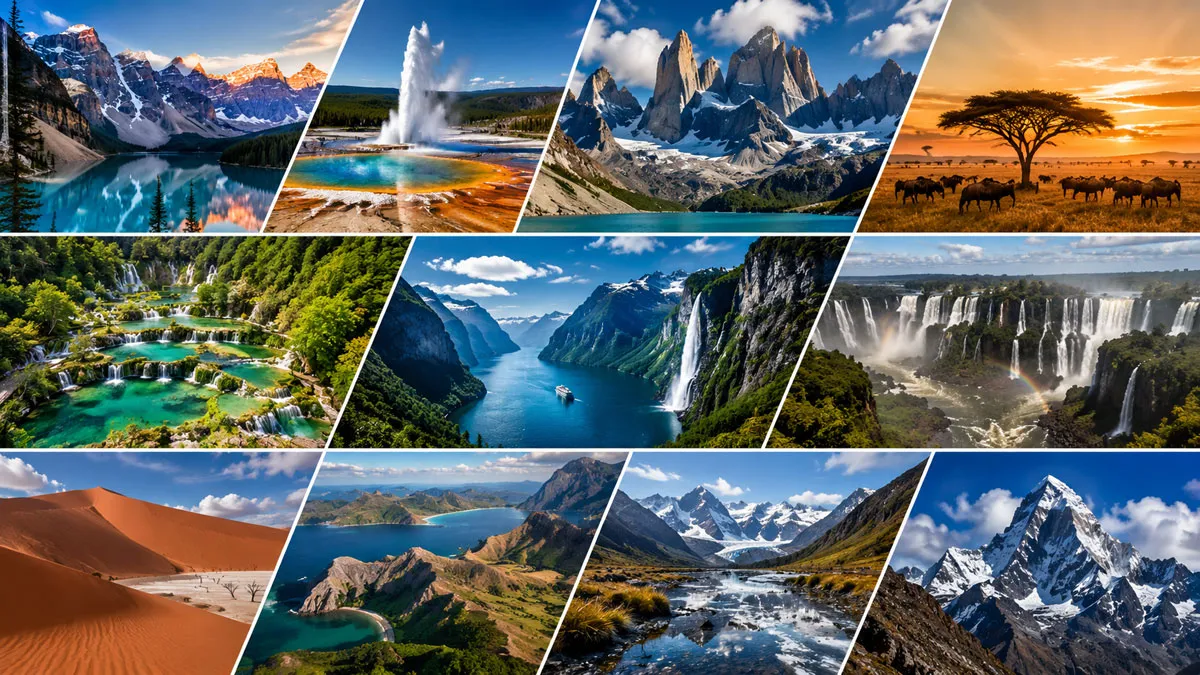
From immense mountain ranges and turquoise lakes to ancient forests, volcanic landscapes, and dramatic coastlines, the world’s national parks protect some of the planet’s most remarkable scenery. The most beautiful parks are not defined by one feature alone; their appeal often comes from the way geology, wildlife, vegetation, water, and changing light combine within a single landscape.
Choosing among them is naturally subjective, but some parks stand out because of their distinctive scenery and exceptional variety. The selection below spans several continents and includes parks known for iconic peaks, vast wilderness, unusual ecosystems, and landscapes that look striking in every season. Accessibility also varies greatly, so the most visually spectacular destination is not necessarily the easiest one to visit.
What Makes A National Park Beautiful?
Beauty in a protected landscape can come from many sources. Some parks are dominated by enormous geological formations, while others are memorable for their forests, waterfalls, glaciers, or wildlife. A park can also become especially compelling when several of these elements occur together.
For travelers, it is useful to look beyond photographs. Seasonal weather, trail conditions, daylight hours, permits, transportation, and conservation restrictions can all affect what can actually be seen. A landscape photographed in summer may look completely different under winter snow, and some remote parks require considerably more preparation than their famous images suggest.
- Geological variety: Mountains, canyons, volcanoes, caves, and unusual rock formations.
- Water features: Glacial lakes, rivers, waterfalls, fjords, and coastlines.
- Plant life: Old-growth forests, tropical vegetation, alpine meadows, and desert flora.
- Wildlife: Native species that add ecological richness to the landscape.
- Scale and wilderness: Large, undeveloped areas where natural scenery dominates the experience.
15 National Parks With Remarkable Scenery
Banff National Park, Canada
Located in Alberta’s Canadian Rockies, Banff is famous for its combination of high mountains, turquoise glacial lakes, dense forests, and broad alpine valleys. Peaks such as Mount Rundle and Mount Temple create a dramatic backdrop, while lakes including Lake Louise and Moraine Lake are among the park’s best-known landscapes.
Banff is also unusually accessible for a large mountain park. The Trans-Canada Highway and a network of established trails make it possible to experience major scenery without undertaking a remote expedition. Summer brings accessible hiking and vivid lake colors, while winter transforms the landscape into a destination for snow sports and frozen-lake scenery.
Fiordland National Park, New Zealand
Fiordland occupies the southwestern corner of New Zealand’s South Island and forms part of Te Wāhipounamu, a UNESCO World Heritage area. Its landscape is shaped by glaciation, producing steep mountains, deep fiords, waterfalls, lakes, and temperate rainforest.
Milford Sound, technically a fiord, is one of the park’s most recognizable sights. Rain is common, but it can also create temporary waterfalls cascading down the cliffs. The combination of rugged terrain and abundant rainfall gives Fiordland a distinctly wild appearance.
Torres Del Paine National Park, Chile
In Chilean Patagonia, Torres del Paine is known for the three granite towers that rise above the surrounding landscape. The park also contains glaciers, lakes, rivers, grasslands, and the dramatic Cuernos del Paine, creating a remarkable mixture of textures and colors.
The famous W and O trekking routes allow visitors to experience different parts of the park on foot. Weather can change rapidly in Patagonia, so conditions and access should be checked before setting out. The park’s beauty is closely connected to its scale: individual viewpoints can reveal mountains, water, and open wilderness within the same panorama.
Yosemite National Park, United States
California’s Yosemite National Park is celebrated for the enormous granite cliffs and waterfalls of Yosemite Valley. El Capitan and Half Dome are particularly recognizable formations, while Yosemite Falls, one of North America’s tallest waterfalls, adds a powerful vertical element to the valley landscape.
Beyond the valley, the park includes high-country meadows, giant sequoias, alpine terrain, and numerous trails. Yosemite’s scenery changes substantially with elevation and season, making the park more diverse than its famous valley photographs alone suggest.
Grand Teton National Park, United States
Grand Teton National Park in Wyoming centers on the sharp peaks of the Teton Range. The mountains rise dramatically from relatively open terrain, creating unusually clear views of the range from valleys, lakes, and meadows.
Jenny Lake, Jackson Lake, and the Snake River provide different perspectives on the mountains. The park is also part of the Greater Yellowstone Ecosystem, a large landscape supporting species such as elk, moose, bison, and grizzly bears. Wildlife viewing requires appropriate distance and caution, particularly around large mammals.
Plitvice Lakes National Park, Croatia
Plitvice Lakes is known for a chain of interconnected lakes, waterfalls, and cascades surrounded by forest. Travertine barriers formed by natural geological and biological processes allow water to move between the lakes at different elevations.
Wooden walkways and designated paths provide access to many viewpoints. Water levels and weather can influence the appearance of individual waterfalls and lakes, while seasonal changes alter the surrounding vegetation. Because the ecosystem is sensitive, visitors are expected to remain on designated routes and avoid entering the water.
Kruger National Park, South Africa
Kruger offers a different kind of beauty from the alpine parks on this list. Its landscapes include savanna, woodland, grassland, and river systems, creating a setting in which wildlife is central to the experience.
The park is one of Africa’s major protected areas for observing large mammals, including elephants, lions, leopards, rhinos, and buffalo. Rather than a single spectacular viewpoint, Kruger’s appeal comes from changing landscapes and the possibility of seeing animals within their natural habitats.
Galápagos National Park, Ecuador
The Galápagos Islands are famous for their unusual volcanic landscapes and extraordinary wildlife. The national park protects most of the archipelago’s land area, including lava formations, beaches, coastal habitats, and highland environments.
Species such as marine iguanas, giant tortoises, sea lions, and blue-footed boobies contribute to the islands’ distinctive character. Because the Galápagos is a fragile ecosystem with strict conservation measures, visiting rules and designated areas are an important part of responsible travel.
Göreme National Park, Türkiye
Göreme’s landscape in Cappadocia is shaped by volcanic rock and erosion. Soft volcanic deposits developed into the distinctive fairy chimneys, valleys, and rock formations for which the region is known.
The landscape is especially striking because natural formations coexist with historic cave dwellings, churches, and other structures carved into the rock. The result is a national park environment in which geological and cultural heritage are closely connected.
Jasper National Park, Canada
Jasper is the largest national park in the Canadian Rockies and combines rugged peaks with glaciers, lakes, forests, and broad river valleys. The Columbia Icefield is one of its major natural features, feeding several important watersheds.
Compared with the highly concentrated scenery around some viewpoints in Banff, Jasper offers a strong sense of spaciousness. Maligne Lake, Athabasca Falls, and the surrounding mountain roads provide access to very different landscapes within the same protected area.
Olympic National Park, United States
Olympic National Park occupies much of Washington State’s Olympic Peninsula and contains an unusually wide range of environments. Within one park are glacier-covered mountains, temperate rainforest, and Pacific coastline.
Hoh Rain Forest is particularly notable for its lush vegetation and moss-covered trees, while Hurricane Ridge provides access to mountainous scenery. The Pacific beaches add yet another character, with rocky shorelines and sea stacks contrasting sharply with the forest inland.
Los Glaciares National Park, Argentina
In southern Patagonia, Los Glaciares National Park protects a vast landscape of mountains, lakes, ice fields, and glaciers. The Southern Patagonian Ice Field supplies numerous glaciers, including Perito Moreno Glacier, one of the park’s best-known attractions.
Perito Moreno is notable not simply for its size but for its active ice movement and accessibility from viewing areas. Elsewhere in the park, Fitz Roy and Cerro Torre create spectacular mountain scenery favored by hikers and climbers.
Jiuzhaigou Valley National Park, China
Jiuzhaigou in Sichuan is recognized for clear lakes, waterfalls, forests, and snow-covered mountains. Its multicolored lakes are associated with mineral-rich deposits and changing water depths, producing striking shades of blue and green.
The valley’s appearance changes through the seasons. Autumn brings colorful foliage, while winter can create a quieter landscape of snow, ice, and partially frozen waterfalls. The park is also part of a region with important biodiversity and conservation value.
Great Smoky Mountains National Park, United States
Straddling Tennessee and North Carolina, Great Smoky Mountains National Park protects one of the largest areas of temperate old-growth forest in the eastern United States. Its rounded mountains, forested ridges, streams, and frequent mist give the park its characteristic appearance.
The park is particularly notable for biodiversity. More than 200 species of birds and numerous amphibians, mammals, and plant species inhabit its varied elevations. Scenic drives and an extensive trail network make its landscapes accessible to visitors with different levels of hiking experience.
Fiordland And The World’s Great Protected Landscapes
Although each park has a different visual identity, several patterns emerge when these destinations are compared. Mountain parks such as Banff, Yosemite, Grand Teton, Torres del Paine, and Los Glaciares emphasize dramatic relief. Fiordland and Olympic combine rugged terrain with exceptionally wet forest ecosystems. Plitvice and Jiuzhaigou place unusual emphasis on water, while Kruger and the Galápagos demonstrate how wildlife can be an essential part of a landscape’s appeal.
| National Park | Country | Signature Landscape |
|---|---|---|
| Banff | Canada | Rocky Mountains and glacial lakes |
| Fiordland | New Zealand | Fiords, rainforest, and mountains |
| Torres del Paine | Chile | Granite peaks, glaciers, and lakes |
| Yosemite | United States | Granite cliffs and waterfalls |
| Grand Teton | United States | Sharp mountain peaks and alpine lakes |
| Plitvice Lakes | Croatia | Cascading lakes and waterfalls |
| Kruger | South Africa | Savanna and wildlife |
| Galápagos | Ecuador | Volcanic islands and endemic wildlife |
| Göreme | Türkiye | Volcanic rock formations and valleys |
| Jasper | Canada | Mountain wilderness and glaciers |
| Olympic | United States | Rainforest, mountains, and coast |
| Los Glaciares | Argentina | Glaciers and Patagonian peaks |
| Jiuzhaigou | China | Colorful lakes and waterfalls |
| Great Smoky Mountains | United States | Forested mountains and misty ridges |
How To Choose A National Park For Your Trip
The right park depends on the type of landscape you want to experience rather than on a universal definition of beauty. Travelers seeking dramatic mountains might focus on the Canadian Rockies or Patagonia, while those interested in forests and coastlines may prefer Olympic. Wildlife-focused trips can look very different from scenic hiking holidays, making parks such as Kruger or the Galápagos particularly distinctive.
Season is equally important. Mountain parks can have substantial snow and limited access outside the main summer period, while tropical or maritime destinations may have very different conditions during wet and dry seasons. Before booking, check the official park authority for current access information, permits, trail closures, transportation requirements, and conservation rules.
Responsible travel matters in every protected landscape. Staying on marked trails, keeping a safe distance from wildlife, carrying out waste, avoiding damage to plants or geological features, and following local restrictions help protect the scenery that makes these places exceptional. In fragile environments, even seemingly small visitor impacts can accumulate over time.
These parks demonstrate that natural beauty has no single formula. A turquoise glacial lake, a mist-covered rainforest, a volcanic island, a Patagonian glacier, and an African savanna can all create very different experiences while sharing the same essential quality: they preserve landscapes where natural processes remain visible on a remarkable scale.
15 Most Beautiful National Parks In The World
Few places reveal the character of a landscape as clearly as a national park. Towering mountains, glacial lakes, ancient forests, volcanic islands, waterfalls, and open savannas can all create extraordinary scenery, often within the boundaries of a single protected area. The most beautiful national parks are therefore not defined by one visual feature, but by the way geology, water, vegetation, wildlife, and light come together.
Beauty is subjective, so there is no objective ranking of the world’s national parks. This selection instead highlights 15 protected landscapes with particularly distinctive scenery and strong reasons to visit. Some are ideal for mountain hiking, others for wildlife encounters or unusual geological formations, and several combine multiple ecosystems in remarkably compact areas.
What Makes A National Park Beautiful?
A spectacular view is only one part of a memorable national park. Landscape diversity can be just as important. A destination that combines mountains with lakes, forests with coastlines, or glaciers with grasslands offers changing scenery rather than a single postcard view.
Natural processes also give many parks their character. Glaciers carve valleys, rivers create waterfalls and canyons, volcanic activity produces unusual rock formations, and climate shapes distinctive forests and wildlife habitats. Understanding these processes can make the scenery more meaningful rather than simply more photogenic.
- Landforms: Dramatic mountains, cliffs, volcanoes, canyons, and unusual rock formations.
- Water: Glacial lakes, waterfalls, rivers, fjords, and coastlines.
- Vegetation: Rainforests, old-growth forests, alpine meadows, and desert or savanna ecosystems.
- Wildlife: Native species that contribute to the character and ecological richness of a landscape.
- Wilderness: Large areas where natural processes remain highly visible and human development is limited.
15 National Parks With Exceptional Scenery
1. Banff National Park, Canada
Banff National Park in Alberta combines the classic elements of the Canadian Rockies: towering mountain peaks, glacial lakes, forests, glaciers, and broad alpine valleys. Parks Canada describes the park as a place where Rocky Mountain peaks and glacial lakes come together, and Banff forms part of the Canadian Rocky Mountain Parks UNESCO World Heritage property.
Lake Louise and Moraine Lake are particularly recognizable because of their striking mountain settings and blue-green water. Beyond these famous locations, the park has extensive mountain scenery and hiking opportunities. Conditions can change quickly, and access to popular areas such as Lake Louise and Moraine Lake can involve seasonal transportation arrangements.
2. Fiordland National Park, New Zealand
On the southwestern side of New Zealand’s South Island, Fiordland National Park is a landscape of steep mountains, deep fiords, lakes, waterfalls, and temperate rainforest. Milford Sound is its best-known destination, but it represents only part of a much larger wilderness landscape.
The region’s heavy rainfall contributes to its lush vegetation and dramatic waterfalls. Fiordland also supports distinctive wildlife, including the Fiordland crested penguin. Its combination of water, forest, and rugged mountains gives the park a character very different from the dry or alpine landscapes found elsewhere.
3. Torres Del Paine National Park, Chile
Chile’s Torres del Paine National Park is one of Patagonia’s most recognizable landscapes. The Cordillera Paine rises above turquoise lakes, rivers, glaciers, forests, and open Patagonian steppe, creating dramatic contrasts across the park.
The three granite towers known as the Torres del Paine are the signature formation, but the park’s scenery extends far beyond them. Multi-day trekking routes provide access to valleys, mountain viewpoints, and glacial landscapes. Patagonia is known for rapidly changing weather, so hikers need to prepare for conditions that can shift during a single day.
4. Yosemite National Park, United States
California’s Yosemite National Park is renowned for its granite cliffs, waterfalls, giant sequoia groves, meadows, and forests. Yosemite Valley concentrates some of its most recognizable scenery, including El Capitan and Half Dome.
Waterfalls are strongly seasonal. Snowmelt generally produces the greatest flows in spring, while some waterfalls can become very small or dry later in summer. This makes the timing of a visit important for travelers whose priority is seeing Yosemite at peak waterfall conditions.
5. Grand Teton National Park, United States
Grand Teton National Park in Wyoming is dominated by the sharp peaks of the Teton Range, which rise dramatically above Jackson Hole. The relatively open valley makes the mountains particularly prominent from roads, meadows, rivers, and lakes.
The park protects a diverse ecosystem as well as its famous mountain scenery. Glaciers, lakes, forests, wetlands, and wildlife habitats occur across different elevations, giving visitors opportunities to experience several types of Rocky Mountain landscape in one destination.
6. Plitvice Lakes National Park, Croatia
Plitvice Lakes National Park is famous for its sequence of interconnected lakes and waterfalls surrounded by forest. Travertine barriers allow water to move from one lake to another, creating a landscape dominated by cascades, pools, and clear water.
Designated paths and wooden walkways provide access to many parts of the lake system. The appearance of individual waterfalls and water levels can change with weather and seasonal conditions. Because the aquatic environment is sensitive, visitors should remain on permitted routes and follow park regulations.
7. Kruger National Park, South Africa
Kruger National Park demonstrates that spectacular scenery does not have to be dominated by mountains. Its landscapes include savanna, woodland, grassland, and river systems, with wildlife forming an essential part of the visual experience.
Large mammals such as elephants, lions, buffalo, rhinoceroses, and leopards are among the species associated with the park. The attraction is not a single landmark but the changing relationship between animals, vegetation, water, and open space across a vast protected landscape.
8. Galápagos National Park, Ecuador
The Galápagos National Park protects a remarkable volcanic island environment where lava formations, beaches, coastal habitats, and highland landscapes occur alongside unusual wildlife. The islands’ isolation has contributed to the evolution of distinctive species and communities.
Giant tortoises, marine iguanas, sea lions, and numerous bird species are among the animals that make the landscape distinctive. The islands are also ecologically fragile, so conservation rules and designated visitor areas are an important part of any trip.
9. Göreme National Park, Türkiye
Göreme National Park and the Rock Sites of Cappadocia offer scenery unlike the classic mountain landscapes found in many national parks. Volcanic deposits were gradually shaped by erosion into valleys, pinnacles, and the formations commonly called fairy chimneys.
The landscape is particularly unusual because geological features and cultural heritage are closely connected. Historic structures were carved into the soft rock, creating a setting in which natural formations and human history appear together.
10. Jasper National Park, Canada
Jasper National Park provides a broad Rocky Mountain landscape of peaks, glaciers, rivers, lakes, forests, and wildlife habitats. Its varied elevation, geology, geography, and climate support a diverse natural environment.
Compared with the concentrated scenery of some famous mountain valleys, Jasper often feels expansive. The park’s large wilderness areas allow visitors to experience mountain landscapes on a different scale, while lakes, waterfalls, and glacier-fed environments provide additional visual variety.
11. Olympic National Park, United States
Washington State’s Olympic National Park is unusual because it combines three major landscape types: rugged Pacific coastline, temperate rainforest, and mountainous terrain. The result is remarkable ecological and visual diversity within one protected area.
The Hoh Rain Forest is characterized by lush vegetation, mosses, and ferns, while coastal areas contain beaches and prominent sea stacks. Higher elevations provide a very different perspective, with mountain scenery replacing the dense greenery of the lower elevations.
12. Los Glaciares National Park, Argentina
Los Glaciares National Park in southern Argentina protects an immense Patagonian landscape of mountains, lakes, ice, and glaciers. The park includes part of the Southern Patagonian Ice Field, from which numerous glaciers descend toward surrounding valleys and lakes.
Perito Moreno Glacier is one of the park’s best-known features, while the Fitz Roy and Cerro Torre areas offer a different form of scenery dominated by sharply defined mountain peaks. Together, these environments illustrate the scale and variety of southern Patagonia.
13. Jiuzhaigou Valley National Park, China
Jiuzhaigou Valley in Sichuan is known for clear lakes, waterfalls, forests, and snow-covered mountains. Its lakes can display vivid shades of blue and green, with their appearance influenced by water depth, minerals, vegetation, and changing light.
The scenery varies considerably by season. Autumn foliage adds strong color to the forested valleys, while winter can transform waterfalls and lakes with snow and ice. The park’s combination of forests, water, and mountain backgrounds gives it a distinctive visual identity.
14. Great Smoky Mountains National Park, United States
Straddling Tennessee and North Carolina, Great Smoky Mountains National Park is known for forested mountains, misty ridges, streams, and exceptional biological diversity. Its rounded peaks differ markedly from the sharp granite formations of Yosemite or the high alpine profiles of the Canadian Rockies.
Elevation changes create a variety of habitats, while old-growth forest and abundant vegetation give many parts of the park a deeply wooded character. Mist is also a defining visual feature, particularly when moisture settles among the mountain ridges and valleys.
15. Fiordland, Banff, And Other Landscapes Worth Comparing
The parks on this list are beautiful for very different reasons. Comparing them by a single standard can obscure what makes each one distinctive. A traveler interested in glaciers may value a very different landscape from someone seeking tropical wildlife, rainforest, or unusual geology.
| National Park | Country | Distinctive Scenery |
|---|---|---|
| Banff | Canada | Rocky Mountain peaks and glacial lakes |
| Fiordland | New Zealand | Fiords, rainforest, mountains, and waterfalls |
| Torres del Paine | Chile | Granite peaks, glaciers, lakes, and steppe |
| Yosemite | United States | Granite cliffs, waterfalls, forests, and meadows |
| Grand Teton | United States | Sharp mountain peaks, lakes, and open valleys |
| Plitvice Lakes | Croatia | Interconnected lakes, cascades, and forests |
| Kruger | South Africa | Savanna, woodland, rivers, and wildlife |
| Galápagos | Ecuador | Volcanic landscapes and distinctive wildlife |
| Göreme | Türkiye | Volcanic valleys and eroded rock formations |
| Jasper | Canada | Mountain wilderness, glaciers, lakes, and forests |
| Olympic | United States | Rainforest, mountains, and Pacific coastline |
| Los Glaciares | Argentina | Glaciers, ice fields, lakes, and Patagonian peaks |
| Jiuzhaigou | China | Colorful lakes, waterfalls, forests, and mountains |
| Great Smoky Mountains | United States | Forested mountains, streams, and misty ridges |
How To Choose The Right Park For Your Trip
The best destination depends largely on what kind of natural scenery you want to experience. Mountain enthusiasts may be drawn to Banff, Grand Teton, Yosemite, Jasper, or Patagonia. Travelers more interested in forests and coastlines have very different options in Olympic and Fiordland, while wildlife can become the central attraction in Kruger or the Galápagos.
Season should also influence the decision. Snow can affect access and hiking conditions in mountain parks, while rainfall can dramatically change waterfalls and forest landscapes. Yosemite, for example, experiences its strongest waterfall flows during the spring snowmelt period. Current trail, road, permit, transportation, and weather information should always be checked with the relevant park authority before traveling.
Responsible tourism is particularly important in protected areas. Staying on designated trails, respecting wildlife distances, avoiding damage to vegetation and geological formations, and following local conservation rules help preserve the landscapes that attract visitors in the first place.
Ultimately, the world’s most beautiful national parks cannot be reduced to one winning landscape. The turquoise lakes of the Canadian Rockies, the fiords of New Zealand, the granite towers of Patagonia, the rainforests of the Pacific Northwest, and the volcanic ecosystems of the Galápagos demonstrate how differently nature can express beauty. Their greatest common feature is the protection of large, distinctive landscapes where natural processes remain visible and meaningful. …