
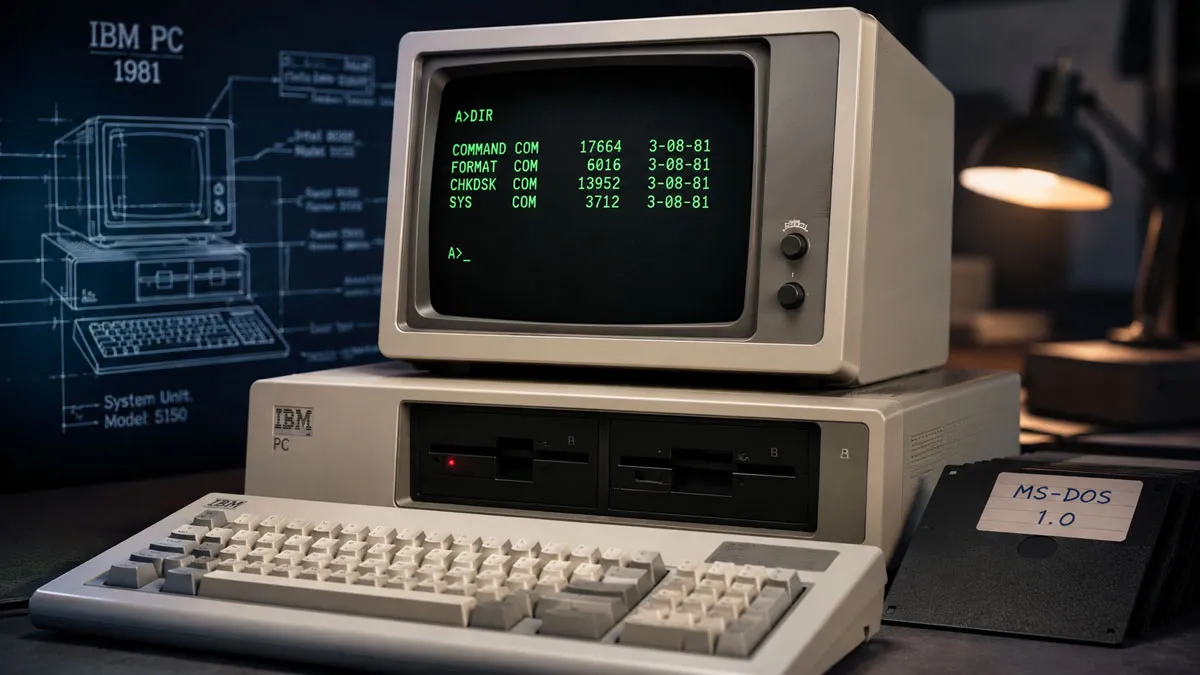
MS-DOS was first released in 1981, alongside the original IBM Personal Computer. The IBM PC was introduced on August 12, 1981, and its operating system was marketed by IBM as PC DOS 1.0 while Microsoft developed and marketed its compatible version as MS-DOS. This distinction is important because the earliest system was closely tied to IBM’s PC DOS branding rather than being sold initially as a standalone Microsoft product.
The First Release Of MS-DOS
The origins of MS-DOS can be traced to 86-DOS, an operating system created by Seattle Computer Products for computers using Intel’s 8086 processor family. Microsoft acquired the rights to 86-DOS in 1981 and adapted the software for IBM’s upcoming personal computer.
When IBM launched the Model 5150 on August 12, 1981, the operating system was supplied as PC DOS 1.0. Microsoft retained the ability to license its version to other computer manufacturers, which became known as MS-DOS.
| Item | Details |
| First IBM PC release | August 12, 1981 |
| IBM’s name | PC DOS 1.0 |
| Microsoft’s name | MS-DOS |
| Original hardware | IBM Personal Computer Model 5150 |
| Processor | Intel 8088 |
Why MS-DOS Is Often Dated To August 12, 1981
August 12, 1981 is commonly given as the release date because it marks the public introduction of the IBM PC and the DOS operating system supplied with it. Microsoft itself records that date as the arrival of MS-DOS on IBM PCs and identifies it as the company’s entry into the operating-system business.
There is, however, a technical distinction between the development history of the software and its public release. The system that eventually became DOS had already gone through several stages before the IBM PC reached customers.
- Seattle Computer Products developed an operating system originally known as QDOS, later called 86-DOS.
- Microsoft obtained rights to 86-DOS and worked with IBM to adapt it for the IBM PC.
- IBM distributed the resulting system as PC DOS 1.0.
- Microsoft subsequently supplied compatible versions to other manufacturers under the MS-DOS name.
How 86-DOS Became MS-DOS
86-DOS was developed by Tim Paterson at Seattle Computer Products. Its design was intended to provide a DOS environment for Intel 8086-based hardware and shared important characteristics with CP/M, an operating system that was already widely used on earlier personal computers.
Microsoft first licensed 86-DOS and later acquired the rights to the software. The company then modified it for IBM’s hardware. This work produced the DOS software that IBM used for its new personal computer.
The arrangement was significant because Microsoft was not limited to supplying software exclusively for IBM. The agreement allowed Microsoft to license its DOS product to other manufacturers. This helped establish MS-DOS as an operating system used across a growing range of IBM-compatible computers.
What MS-DOS 1.0 Was Like
The first DOS environment was extremely small by modern standards. It was designed for the hardware of the early 1980s and primarily provided a command-line environment for managing files, running programs, and working with floppy disks.
Unlike modern operating systems, MS-DOS did not provide a graphical desktop with windows, icons, and a mouse-driven interface. Users generally entered commands at a text prompt.
The original DOS release also had significant storage limitations. PC DOS 1.0 was designed around the floppy-disk hardware available in the first IBM PC and did not provide the hierarchical directory structure that later DOS versions introduced.
What Happened After The First Release?
MS-DOS developed rapidly as personal computers became more capable. Version 1.1 followed in 1982, adding support for double-sided floppy disks. A much more substantial change arrived with DOS 2.0 in 1983.
DOS 2.0 was released with the IBM PC XT and introduced features including support for hard disks and hierarchical subdirectories. These additions made DOS considerably more useful for larger programs and increasing amounts of stored data.
Later releases added memory-management features, networking capabilities, improved disk support, utilities, and other functions. MS-DOS remained an important foundation for IBM-compatible personal computers throughout the 1980s and much of the 1990s.
MS-DOS And The Rise Of Windows
MS-DOS eventually became closely associated with Microsoft Windows. The first version of Windows, released in 1985, operated as a graphical environment on top of MS-DOS rather than immediately replacing it with an entirely separate operating system.
For many years, users could start a computer in DOS and then launch Windows from the command line. As Windows evolved, its graphical environment became increasingly central to everyday PC use, reducing the role of DOS.
The Key Date To Remember
If you are looking for the standard historical date, the answer is August 12, 1981. That was the day IBM introduced the original IBM PC with PC DOS 1.0, the IBM-branded version of the DOS system that Microsoft developed and later marketed more broadly as MS-DOS.
The development story began earlier with 86-DOS, so August 12, 1981 should be understood as the public launch date associated with the first IBM PC and its DOS operating system, rather than the beginning of DOS development itself.