
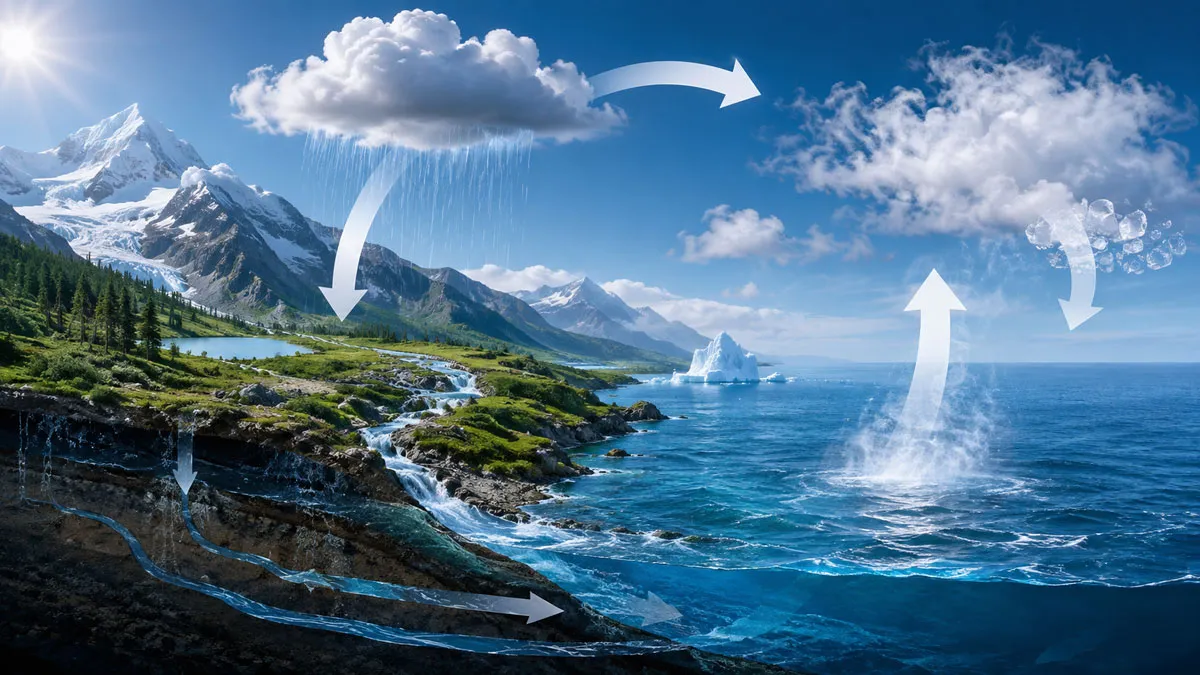
Rivers constantly carry water into the oceans, and rain falls on their surfaces, so why don’t the oceans simply keep filling up? The answer lies in Earth’s water cycle. Water is constantly moving between the oceans, atmosphere, land, and ice. While rivers and rainfall add water to the oceans, evaporation continuously removes water from their surfaces and sends it back into the atmosphere.
Some of the water that falls as precipitation returns directly to the ocean. The rest falls on land, where it eventually makes its way back to the sea through rivers, groundwater, and runoff.
The key point is that the ocean is not a container receiving water from a one-way supply. It is the largest reservoir in a continuous global circulation system. On a global scale, evaporation and precipitation remain closely balanced over time. Differences between the ocean and land are largely offset by atmospheric moisture transport and by water flowing from land back into the sea.
How Water Moves In and Out of the Oceans
Sunlight provides the energy that drives evaporation from the ocean’s surface. As liquid water warms, some of it changes into water vapor and enters the atmosphere. When that vapor cools, it condenses into tiny droplets, forming clouds. Eventually, the water returns to Earth’s surface as precipitation.
Once precipitation reaches the ground, gravity takes over. Water can flow downhill across the surface as runoff, collect in streams and rivers, or seep into the ground and become groundwater. Eventually, much of this water makes its way back to the ocean.
| Process | What Happens | Where the Water Goes |
|---|---|---|
| Evaporation | Liquid ocean water changes into water vapor. | Atmosphere |
| Condensation | Water vapor cools and forms tiny droplets that make up clouds. | Clouds and atmosphere |
| Precipitation | Water falls to Earth’s surface as rain, snow, sleet, or hail. | Ocean or land |
| Runoff | Water flows across the land into streams and rivers. | Eventually, much of it reaches the ocean |
| Groundwater Flow | Water moves underground through soil and rock. | Rivers, lakes, or the ocean |
Does More Water Enter the Oceans Than Leaves Them?
At any given moment, different parts of the water cycle can be out of balance. Over long periods, however, the global system remains approximately balanced. The oceans receive water from direct precipitation as well as from rivers, runoff, and groundwater flowing from land. At the same time, enormous amounts of water are continuously removed from the ocean through evaporation.
According to the U.S. Geological Survey (USGS), evaporation over the oceans is greater than precipitation falling directly onto them. This difference is largely balanced by the movement of atmospheric moisture from the oceans to land. Over land, precipitation generally exceeds evaporation, and the excess water eventually returns to the oceans through rivers, streams, runoff, and groundwater discharge.
- Over the oceans: evaporation generally exceeds precipitation.
- Over land: precipitation generally exceeds evaporation.
- From land to ocean: rivers, runoff, and groundwater return water to the sea.
- Through the atmosphere: winds transport water vapor from the oceans toward land.
Why Doesn’t River Water Keep Raising Sea Level?
A river does add water to the ocean, but that water is part of a much larger circulation system. Before reaching the river, it may have fallen as rain or snow, entered the soil or groundwater, flowed through a watershed, and eventually made its way to the sea. At the same time, ocean water is constantly being transferred back into the atmosphere through evaporation.
That’s why it can be misleading to think of rivers as continuously adding new water to the oceans. The same water molecules can move repeatedly between the ocean, atmosphere, land, rivers, groundwater, and ice. The water cycle has no permanent beginning or end.
Why Doesn’t Evaporation Make the Oceans Disappear?
Evaporation from the oceans is enormous, but most of the resulting water vapor eventually returns to the ocean as precipitation. Only a portion of the moisture evaporated from the oceans is carried over land.
The USGS estimates that roughly 10 percent of the water evaporated from the oceans is transported over land and falls there as precipitation. This movement of moisture helps maintain the balance between the ocean and land parts of the water cycle.
In other words, the ocean loses water through evaporation, but it also receives water through direct precipitation and through the return of water from land. Without these return flows, the oceans would gradually lose water instead of maintaining their present volume.
Are Ocean Levels Completely Constant?
No. The water cycle prevents the oceans from simply filling up indefinitely, but ocean levels can and do change. Water can be temporarily stored in glaciers, ice sheets, groundwater, lakes, soil, and the atmosphere. Changes in the amount of water stored in these reservoirs can affect how much water remains in the oceans.
Sea level can also change because seawater expands as it warms. Over longer periods, changes in land ice and other parts of the climate system can contribute to changes in ocean volume and sea level.
These changes are separate from the basic question of why rainfall and rivers do not cause the oceans to fill endlessly. The important point is that Earth’s water is constantly moving between different reservoirs rather than accumulating permanently in the oceans.
The Simple Answer
The oceans don’t overflow because Earth’s water is constantly circulating rather than accumulating in one place. Rain and rivers move water into the oceans, while evaporation moves water back into the atmosphere. Winds transport some of that moisture over land, where precipitation eventually sends much of it back toward the sea through rivers, runoff, and groundwater.
In other words, the ocean is not the final destination of Earth’s water. It is the planet’s largest water reservoir, part of a continuous cycle in which water is constantly exchanged among the ocean, atmosphere, land, and frozen parts of Earth. …