
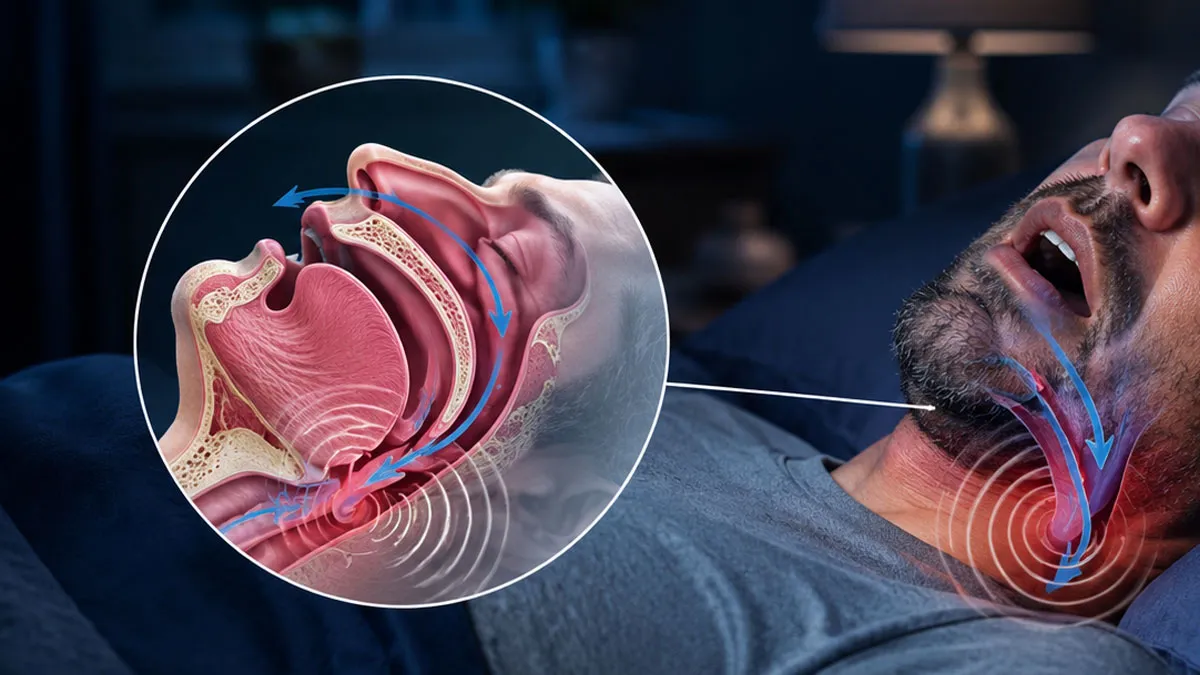
Snoring happens when air cannot move freely through the nose or throat during sleep, causing relaxed tissues in the upper airway to vibrate. The sound may be occasional or persistent, and it can become more noticeable when the airway is narrowed by nasal congestion, sleep position, alcohol, body weight, or the natural structure of the mouth and throat.
Most snoring is not dangerous by itself, but persistent or unusually loud snoring can sometimes be a sign of obstructive sleep apnea (OSA). The important distinction is whether breathing remains continuous or repeatedly becomes restricted or stops during sleep. Recognizing that difference can help determine whether simple changes may be enough or whether medical evaluation is appropriate.
What Happens In The Airway When You Snore?
During sleep, muscles in the tongue, soft palate, throat, and surrounding tissues naturally relax. If the airway becomes narrower, air has to pass through a smaller space. The resulting airflow can make the soft tissues vibrate, producing the rough or raspy sound associated with snoring.
Several factors can make this narrowing more likely:
- Sleeping on the back can allow gravity to narrow the airway.
- Alcohol can relax throat muscles and make airway obstruction more likely.
- A blocked or congested nose can make breathing more difficult.
- Extra tissue around the upper airway can contribute to narrowing.
- A naturally narrow throat, enlarged tonsils, or certain mouth and jaw structures can affect airflow.
- Sleep deprivation can increase relaxation of the tissues in the throat.
Why Do Some People Snore More Than Others?
Snoring is influenced by a combination of anatomy, sleep habits, and health factors rather than by one single cause. People with chronic nasal congestion, a deviated nasal septum, a narrow airway, or enlarged tonsils may be more susceptible. Excess body weight can also increase the amount of tissue around the upper airway and raise the likelihood of snoring.
Age and family history can also play a role. Snoring and obstructive sleep apnea become more common with age, while inherited airway characteristics can influence an individual’s risk. Alcohol consumption and smoking are additional modifiable factors that can worsen airway problems during sleep.
| Possible Factor | How It Can Affect Snoring |
|---|---|
| Sleeping on your back | Can allow the tongue and other tissues to move toward the back of the throat. |
| Alcohol before sleep | Can increase relaxation of throat muscles and make airway narrowing more likely. |
| Nasal congestion | Restricts nasal airflow and can encourage mouth breathing. |
| Excess body weight | May increase tissue around the upper airway and contribute to narrowing. |
| Airway anatomy | A narrow throat, enlarged tonsils, or other structural features can reduce available airflow. |
When Is Snoring A Sign Of Sleep Apnea?
Not everyone who snores has sleep apnea, and snoring alone cannot establish a diagnosis. Obstructive sleep apnea occurs when the upper airway repeatedly becomes blocked during sleep, interrupting normal breathing. The person may briefly wake or partially awaken to reopen the airway, sometimes without remembering it the next morning.
Snoring deserves medical attention when it occurs alongside signs such as:
- Breathing pauses noticed by another person.
- Gasping, choking, or snorting during sleep.
- Excessive daytime sleepiness despite apparently adequate sleep.
- Morning headaches or a dry or sore throat.
- Difficulty concentrating or persistent irritability.
- Loud snoring that regularly disrupts another person’s sleep.
These symptoms do not prove that someone has sleep apnea, but they are reasons to discuss the problem with a healthcare professional. A sleep evaluation may include an overnight sleep study or, in appropriate circumstances, a home sleep test.
What Can Help Reduce Snoring?
The most useful approach depends on why the airway is narrowing. For occasional or uncomplicated snoring, changes that improve airflow may reduce the problem. Sleeping on your side rather than your back can help some people, while limiting alcohol near bedtime may reduce throat relaxation. Treating persistent nasal congestion and getting sufficient sleep can also be useful.
For people who are overweight, achieving and maintaining a healthy weight may improve snoring and can also reduce the risk or severity of obstructive sleep apnea. Quitting smoking is another potentially helpful change because smoking can contribute to inflammation in the upper airway.
If obstructive sleep apnea is diagnosed, treatment may involve positive airway pressure such as CPAP, an appropriately fitted oral appliance, lifestyle changes, or, in selected cases, surgery. Treatment should be matched to the underlying cause rather than chosen solely because it promises to make snoring quieter.
Why The Sound Of Snoring Is Not The Whole Story
A louder snore does not automatically mean a more severe medical problem. The more important question is whether breathing is being repeatedly disrupted. Someone can have bothersome snoring without sleep apnea, while another person may have significant sleep-disordered breathing that is not obvious from the sound alone.
For that reason, persistent snoring should be considered in the context of other symptoms and risk factors. If breathing pauses, nighttime choking, or significant daytime sleepiness are present, medical assessment is more important than simply trying to silence the snoring. Identifying and treating an underlying sleep disorder can address both the nighttime breathing problem and its effects on daytime health. …