
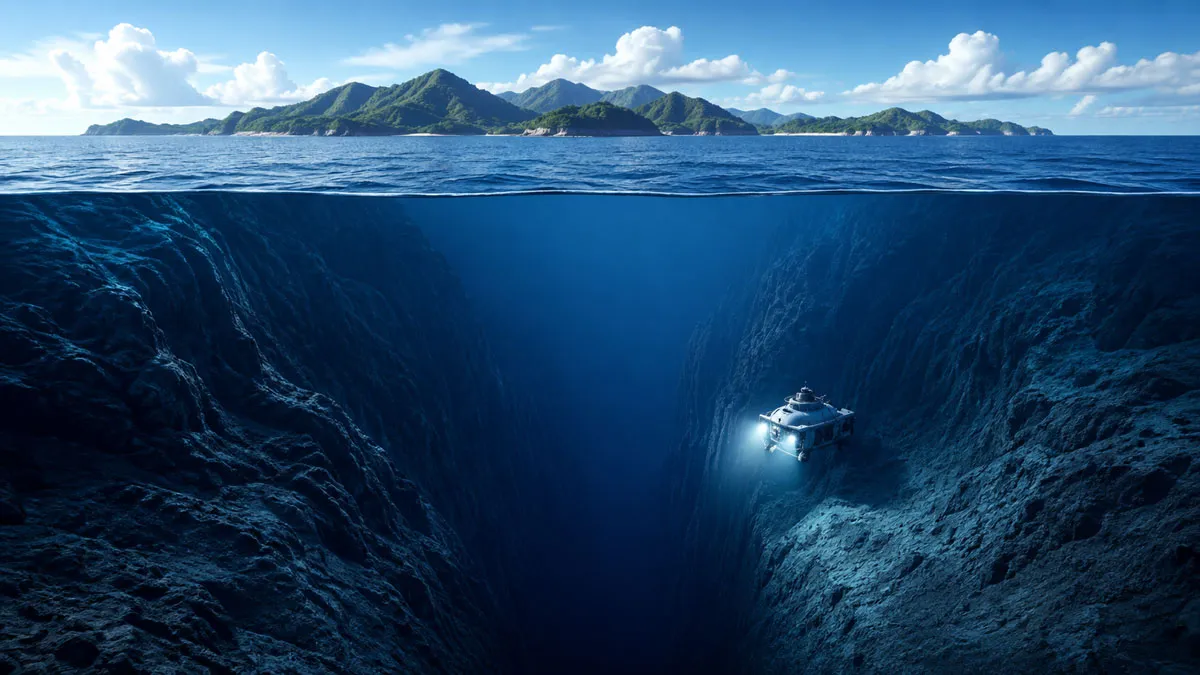
The deepest known point in the world’s oceans is found in the Mariana Trench, a vast underwater depression in the western Pacific Ocean. At its deepest point, known as Challenger Deep, the seafloor lies approximately 10,935 meters (35,876 feet), or about 6.8 miles, below mean sea level.
That is nearly three times the average depth of the world’s oceans, which is about 3,682 meters (12,080 feet). To put it another way, Challenger Deep reaches almost 11 kilometers into the Earth’s crust beneath the ocean.
The exact depth is a little more complicated than simply measuring from the surface to the seafloor. Oceanographers have to account for factors such as water temperature, salinity, pressure, gravity, and changes in sea level. A detailed analysis published in 2021 estimated the deepest observed seafloor at Challenger Deep at 10,935 meters, with an uncertainty of about ±6 meters at a 95% confidence level.
How Deep Is Challenger Deep?
Challenger Deep is the deepest known part of the Mariana Trench and the deepest known location in Earth’s oceans. Modern measurements place it at roughly 10.9 kilometers below mean sea level.
| Measurement | Approximate Depth |
|---|---|
| Challenger Deep | 10,935 meters (35,876 feet) |
| Challenger Deep in miles | About 6.8 miles |
| Average ocean depth | 3,682 meters (12,080 feet) |
| Mount Everest elevation | 8,848 meters (29,029 feet) |
You may see slightly different numbers for Challenger Deep depending on the source. Measurements have varied because the seafloor is difficult to survey and different expeditions have used different instruments and methods. Figures around 10,900 meters and 11,000 meters are therefore common, while 10,935 meters is a modern, carefully analyzed estimate based on submersible observations.
Where Is the Mariana Trench?
The Mariana Trench lies in the western Pacific Ocean, east of the Philippines and close to Guam and the Mariana Islands. It stretches in a long, curved shape along a major tectonic boundary.
The trench formed at a subduction zone, where the Pacific Plate is pushed beneath the Philippine Sea Plate. This movement has created one of the deepest and most dramatic features on Earth’s surface.
- Ocean: Western Pacific Ocean
- Deepest point: Challenger Deep
- Maximum measured depth: About 10,935 meters
- Geological setting: Subduction zone
- Nearby region: Mariana Islands and Guam
The deepest point itself occupies only a relatively small area. The Mariana Trench as a whole is a much larger geological feature extending for hundreds of kilometers.
How Does the Mariana Trench Compare With Mount Everest?
Mount Everest is about 8,848 meters (29,029 feet) above mean sea level. Challenger Deep, by comparison, reaches approximately 10,935 meters below mean sea level.
The difference is about 2,087 meters, or more than 2 kilometers.
One way to visualize the scale is to imagine placing Mount Everest at the bottom of Challenger Deep. Even if its base were sitting on the seafloor, its summit would still be more than 2 kilometers below the ocean surface.
That is one reason the depth of Challenger Deep is so difficult to imagine. It is deeper than Everest is tall.
Why Is Measuring the Mariana Trench So Difficult?
Measuring a feature almost 11 kilometers beneath the ocean surface is a major technical challenge. At that depth, pressure is enormous, there is no sunlight, and the instruments have to operate reliably in extremely cold water.
Scientists use several techniques to determine the depth of the trench. These include multibeam sonar, pressure sensors, acoustic altimeters, and precise measurements of seawater properties. Corrections also have to be made for factors such as gravity and variations in the speed of sound through seawater.
The 2021 estimate of 10,935 meters was based on observations from several submersible transects and pressure measurements rather than a single sounding. This approach allowed researchers to estimate the depth more precisely.
Earlier expeditions produced somewhat different results. In 1960, the bathyscaphe Trieste carried Jacques Piccard and U.S. Navy Lieutenant Don Walsh to Challenger Deep. Their measurement was later revised as scientists developed better techniques for measuring ocean depth.
Since then, increasingly sophisticated sonar systems, pressure sensors, and crewed and uncrewed submersibles have helped improve our understanding of the trench.
What Happens at the Bottom of the Mariana Trench?
Challenger Deep lies within the hadal zone, the deepest region of the ocean. Conditions there are unlike those found almost anywhere else on Earth.
There is no sunlight at that depth, and the pressure is enormous. Temperatures are only a few degrees above freezing. Despite these harsh conditions, the seafloor is not completely lifeless.
Scientists have found microorganisms and deep-sea animals in the Mariana Trench and other hadal environments. Some organisms have adaptations that allow them to survive under pressures that would be fatal to most surface-dwelling life.
Exploring the area is equally challenging for machines. Submersibles need specially designed pressure-resistant structures and instruments capable of working in darkness and under extreme pressure.
Why Does the Mariana Trench Matter?
The Mariana Trench is interesting not only because it contains the deepest known point in the ocean. It is also an important natural laboratory for scientists studying life under extreme conditions and the geological processes that shape the planet.
Because the trench sits at a subduction zone, researchers can study how oceanic crust is pushed into Earth’s interior. The region also provides clues about how water and other materials move through the deep Earth.
Biologists are interested in the trench for another reason: the organisms living there have evolved to cope with extreme pressure, limited food, darkness, and cold temperatures. Studying them can help scientists understand the limits of life on Earth.
So, How Deep Is the Mariana Trench?
The simplest answer is about 10,935 meters (35,876 feet) at Challenger Deep, the deepest known point in the Mariana Trench and the deepest known location in Earth’s oceans.
The exact number can vary slightly between surveys because measuring such a remote and extreme environment is difficult. But whether the figure is given as 10,900 meters, 10,935 meters, or roughly 11 kilometers, the scale is the same: Challenger Deep extends almost 11 kilometers below mean sea level.
That makes the Mariana Trench one of the most extraordinary places on our planet—not just because of its depth, but because of the geology and life that exist in a world almost completely cut off from the surface.
Bu versiyonda özellikle tekrarlı AI kalıplarını, gereksiz “özetleyen” cümleleri ve aşırı mekanik geçişleri azalttım. Aynı zamanda metni fazla gündelikleştirip bilimsel güvenilirliğini düşürmedim. …