
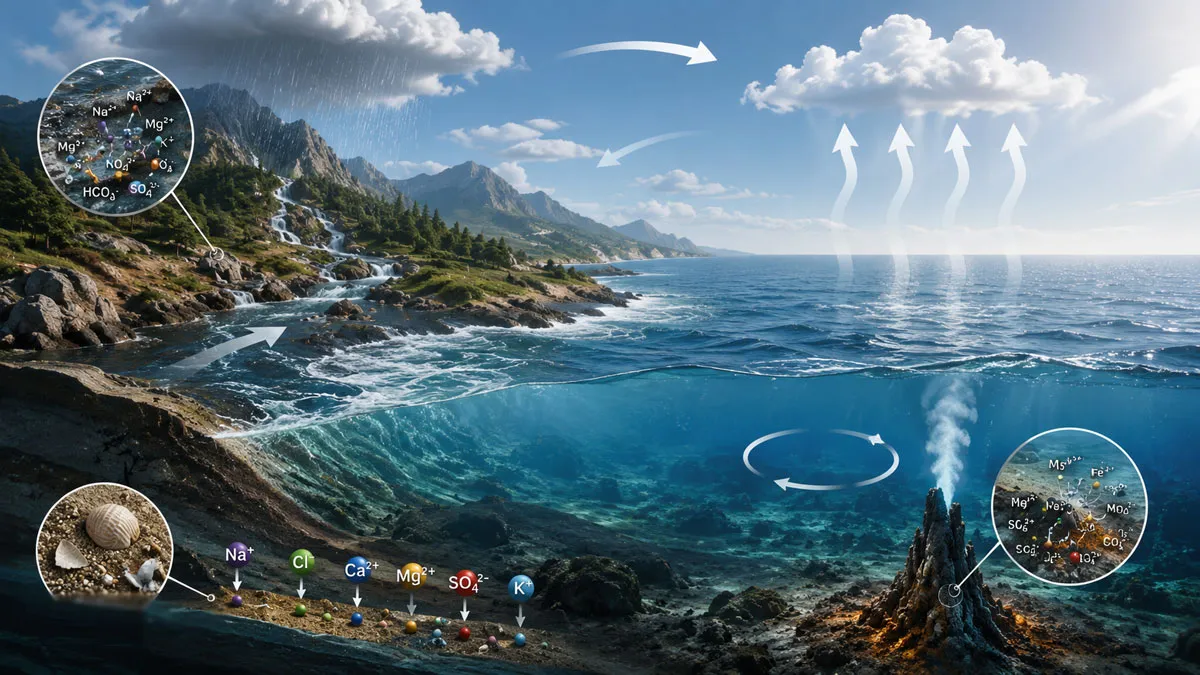
Sea water is salty because it contains dissolved minerals and ions that have accumulated in the ocean over geological time. Rainwater and weathering gradually break down rocks on land, releasing substances such as sodium, chloride, magnesium, calcium, and sulfate. Rivers then carry many of these dissolved materials toward the sea, where they become part of the ocean’s chemical mixture.
The process is not limited to rivers. Hydrothermal vents and underwater volcanic activity also add dissolved minerals to seawater, while other natural processes remove some substances from the ocean. Evaporation further concentrates the salts because water vapor leaves the ocean while most dissolved salts remain behind. The result is seawater with an average salinity of about 35 parts per thousand, or roughly 3.5% dissolved salts by weight.
How Salt Gets From Rocks Into The Ocean
The journey begins with precipitation. Rainwater naturally absorbs carbon dioxide from the atmosphere, making it mildly acidic. As rain falls onto exposed rocks, it causes both physical erosion and chemical weathering. These processes release minerals in the form of dissolved ions.
Streams collect water from the landscape and eventually feed rivers. Rivers therefore transport a continuous supply of dissolved minerals toward the ocean. The concentration in an individual river may be low enough that the water tastes fresh, but the world’s rivers collectively deliver large quantities of dissolved material over very long periods.
Once these substances reach the ocean, some are incorporated into marine organisms or minerals and eventually removed from seawater. Others remain dissolved for much longer. The balance between inputs and removal helps determine the ocean’s overall chemical composition.
- Rain and weathering: Break down rocks and release dissolved ions.
- Rivers: Transport minerals from land to the ocean.
- Hydrothermal vents: Release dissolved minerals after seawater reacts with hot oceanic crust.
- Underwater volcanism: Adds minerals and other chemical substances to seawater.
- Evaporation: Removes water while leaving most dissolved salts behind.
What Is Actually Dissolved In Sea Water?
Sea water is not simply fresh water mixed with table salt. It contains many dissolved substances. Sodium and chloride are the dominant ions and together account for most of the dissolved ions in seawater. Magnesium and sulfate are also important components, along with smaller quantities of calcium, potassium, bicarbonate, and other substances.
| Component | Role In Seawater |
|---|---|
| Sodium | One of the most abundant dissolved ions |
| Chloride | The other major ion associated with seawater’s saltiness |
| Magnesium | A significant dissolved mineral and an important part of marine chemistry |
| Sulfate | A major dissolved ion found throughout seawater |
| Calcium | Important for marine organisms that build shells and skeletons |
Why Doesn’t The Ocean Become Saltier Forever?
It may seem that if rivers continually deliver minerals to the sea, ocean salinity should increase without limit. In reality, the ocean has natural removal processes. Dissolved substances can be taken up by organisms, incorporated into sediments, or involved in chemical reactions with rocks on the seafloor. Some material is also removed as minerals precipitate and settle.
For this reason, ocean salinity reflects a long-term balance between processes that add dissolved substances and processes that remove them. The modern ocean is not simply accumulating every mineral ever carried into it.
Why Is Some Sea Water Saltier Than Other Sea Water?
Salinity is not identical everywhere. Local conditions change the concentration of dissolved salts, particularly the balance between water entering and leaving a region.
High evaporation can increase salinity because relatively pure water is transferred to the atmosphere while dissolved salts remain. Heavy rainfall, river discharge, and melting ice can have the opposite effect by adding freshwater. Ocean currents then redistribute water and help mix regions with different salinities.
| Process | Typical Effect On Salinity |
|---|---|
| Strong evaporation | Raises salinity |
| Heavy rainfall | Lowers salinity |
| River discharge | Lowers salinity near river mouths |
| Melting ice | Adds freshwater and can lower local salinity |
| Freezing seawater | Leaves much of the salt behind and can increase the salinity of surrounding water |
Why Do Rivers Taste Fresh If They Carry Salt?
River water is not completely free of dissolved minerals. It simply contains much less dissolved salt than typical seawater. The minerals are usually present at concentrations that do not produce the strong salty taste associated with the ocean.
The difference becomes significant over geological timescales. Individual rivers may carry relatively dilute water, but countless rivers and streams have transported dissolved material toward the oceans throughout Earth’s history. The ocean acts as the long-term receiving basin for much of this material.
Why Does Sea Water Taste Salty?
The familiar salty taste comes mainly from dissolved ions, especially sodium and chloride. These ions are present at concentrations high enough for our taste receptors to detect them readily. Because seawater also contains magnesium, sulfate, calcium, and other dissolved substances, its taste is not identical to a glass of water containing only sodium chloride.
In simple terms, the ocean is salty because minerals released from rocks and other geological processes have accumulated in seawater over immense periods, while evaporation concentrates dissolved substances and natural removal processes keep the system in balance. …